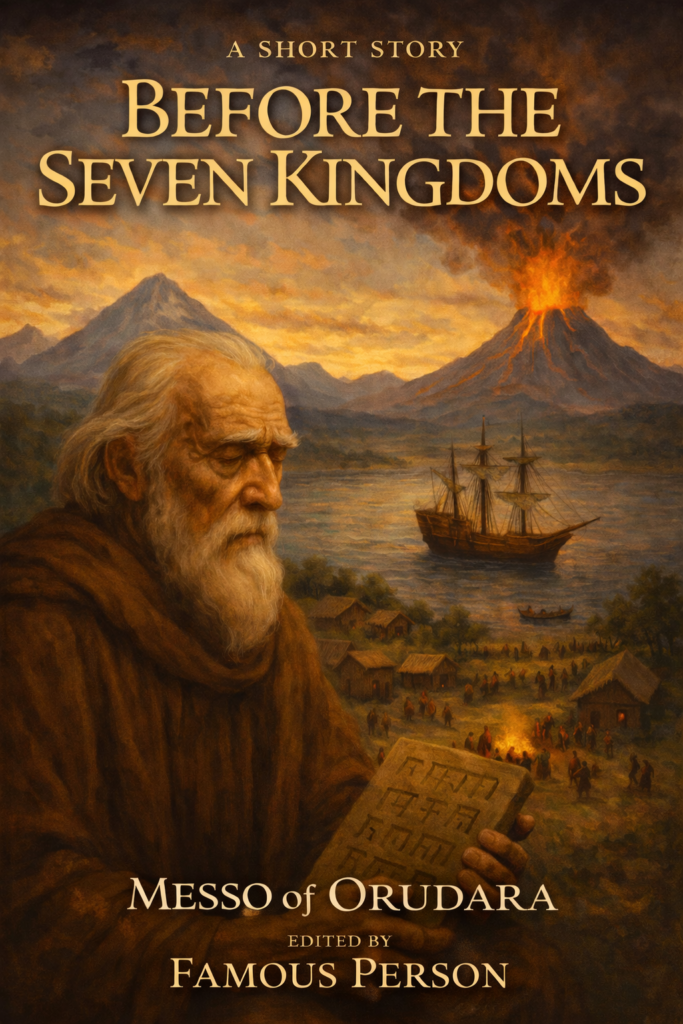
A World Shaped by Human Choice
No Gods. No Magic. Only Everyday Choices.
Where do you cast your anchor?
What will you stand by when standing costs you everything?
Every story here is shaped by choices no one else could make.
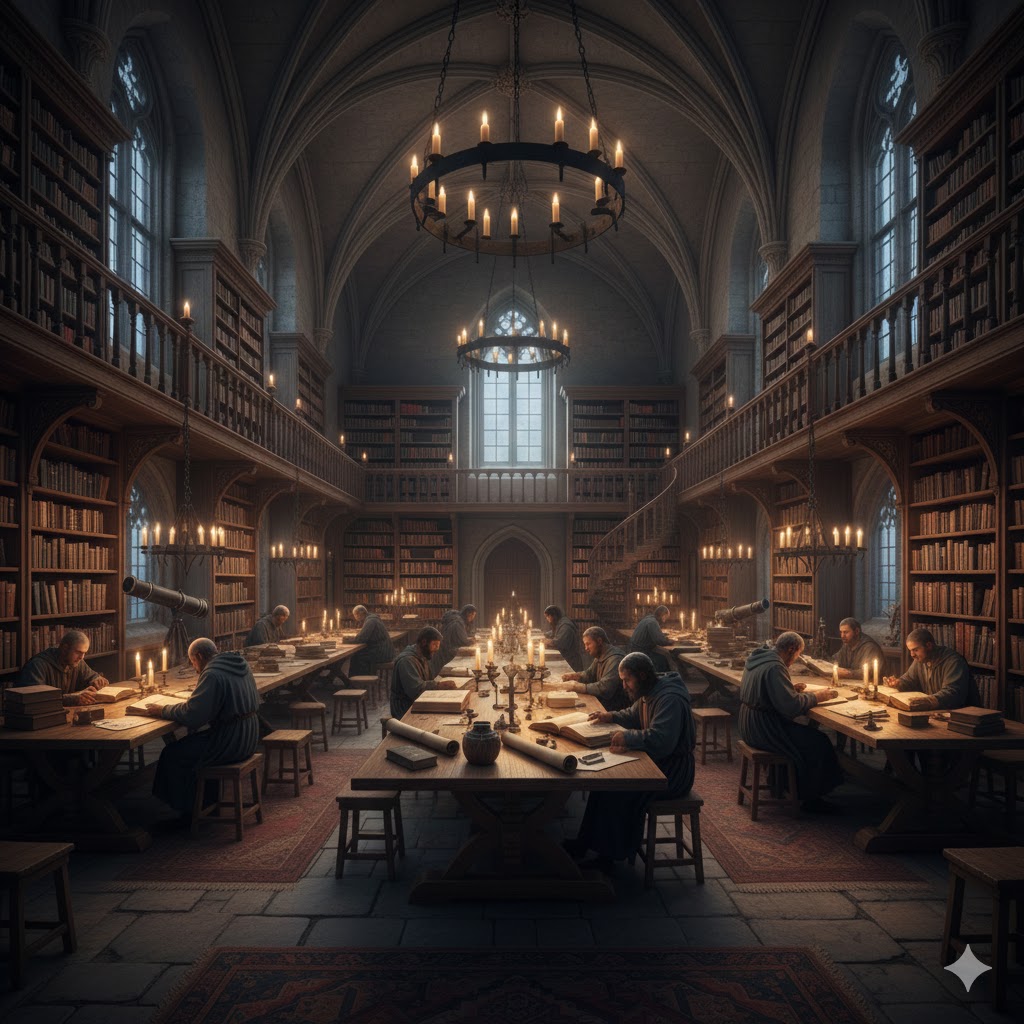
Read the stories. Search for your reflection. Choose your path.
The Thalevirian Archives Page Map
Introduction to The Thalevirian Archives
In Thalevir, there are no gods or religion. There are no prophets, priests, magic, or monsters. Importantly, there are also no prophecies nor destinies. Instead, the choices people make and the opportunities they dare to seize govern this world.
Without a central moral anchor, geography and personality drive ethics. Consequently, guild codes and local laws dictate morals in the cities and villages. In the wild, the rawest human impulses rule. Selfishness or selflessness, sacrifice or hedonism—the consequences of these choices depend entirely on the reactions of those around them.
These records document the psychological realism of a civilization. It is a world built on the grounded physics of its soil and the shifting motivations of those who walk it.
The Geography of Thalevir
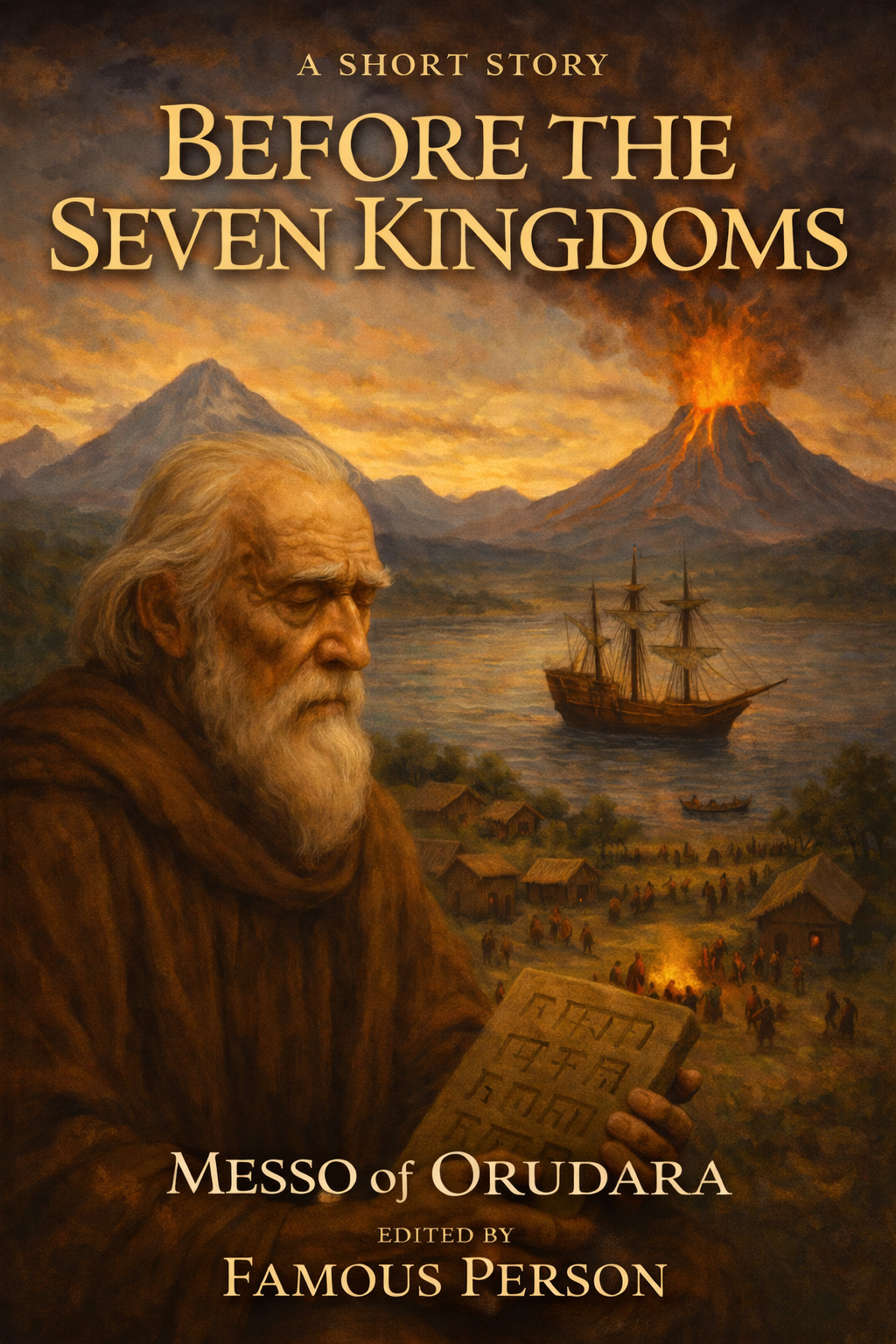
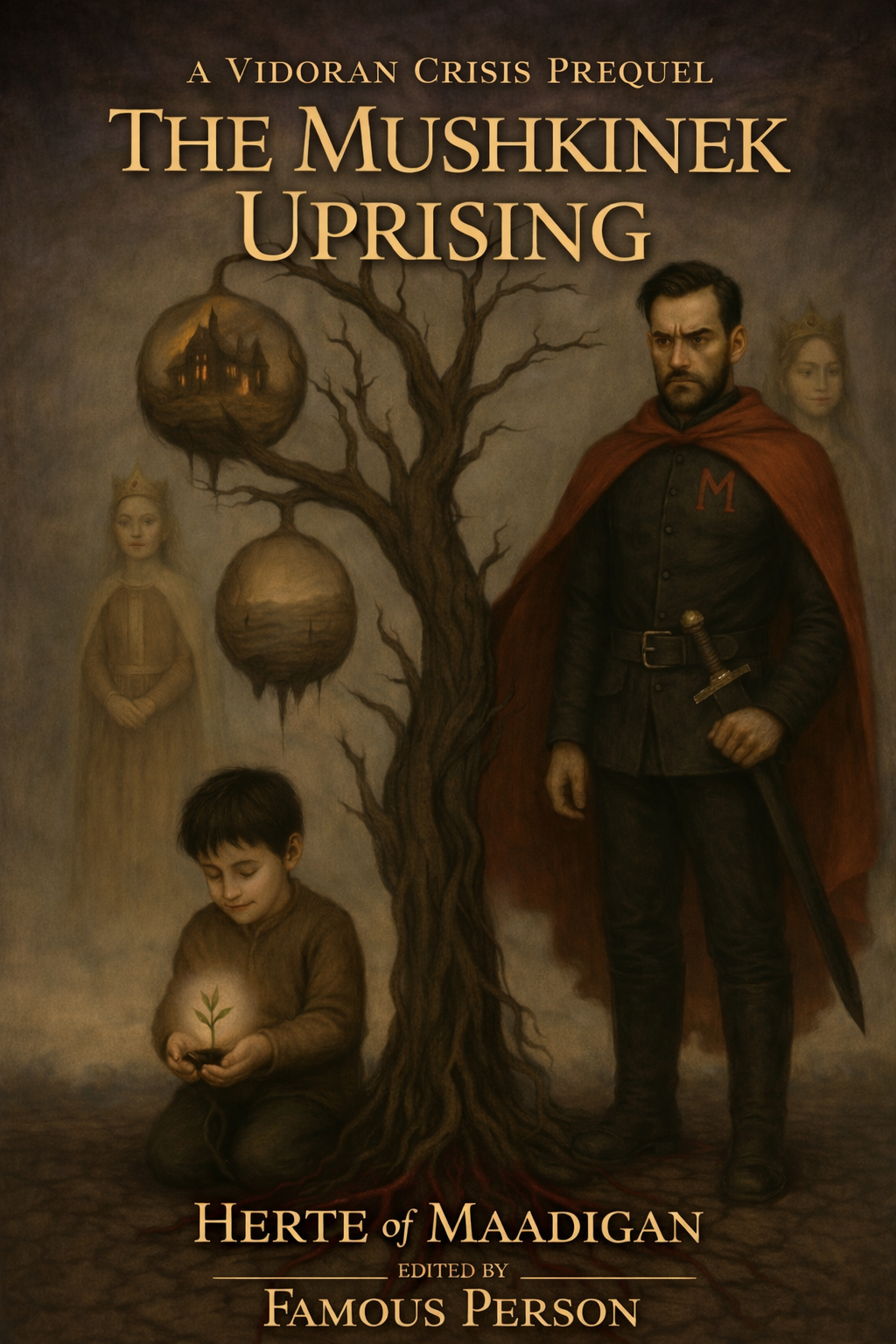
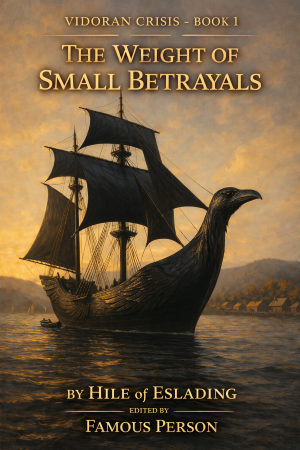
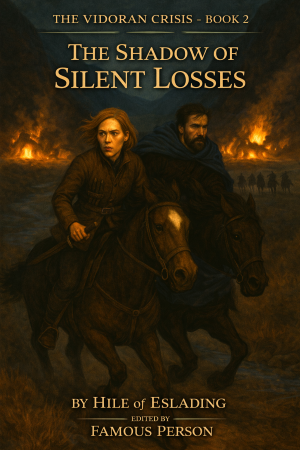
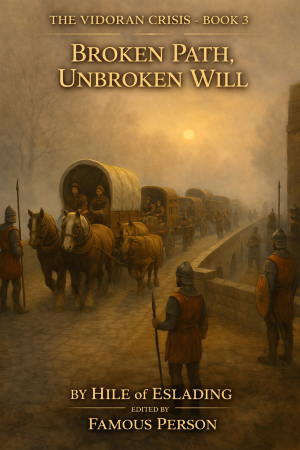
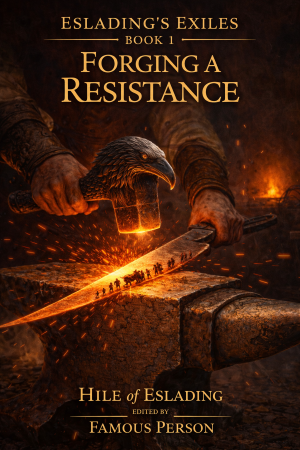
Thalevir [THAL-EH-VEER] serves as the setting for several records. These include the short story Before the Seven Kingdoms, The Mushkinek Uprising, and The Vidoran Crisis trilogy. Additionally, the upcoming Eslading’s Exiles trilogy takes place here. Quiet beauty and sudden violent upheaval define Thalevir. While its people navigate anchorless morality, the vast and indifferent geography divides the world itself.
Only two of Thalevir‘s four continents have ever been inhabitable: Cendomvita [SIN-DOHM-VEE-TAH] and Orudara [OH-ROOH-DAHR-AH]. Currently, the people on each continent believe themselves alone in a silent sea. They rarely acknowledge the existence of others. If they do, they only speak in whispers of fragmented myths and half-forgotten legends.
About Cendomvita: The Continent of the Seven Kingdoms
Click to Navigate About Cendomvita
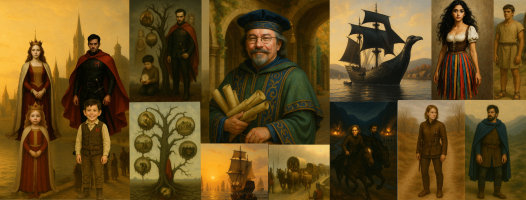
Origins
What people choose to forget partly defines the Cendomvitan continent. Rumors, myths, and legends tell of a great scourge from the past. This event arose in Orudara, the forgotten homeland, thousands of years before the stories I share.
Significantly, this was not a scourge of nature. Instead, it was a scourge of man’s selfishness and innate evil. In desperation, countless people fled to seek survival across the sea. Many of these refugees eventually landed along the coasts of Cendomvita. Consequently, the survivors assumed the rest were lost to the sea.
The Rise of the Seven Kingdoms
The survivors spread across the continent to establish small settlements. Each group was initially ignorant of the others. These pioneers built homes along the coasts and navigable waterways.
Over several centuries, these settlements expanded into villages and matured into towns. Eventually, they transformed into cities. This growth led to the birth of Cendomvitan civilization. By blending Orudaran memories with the harsh realities of starting over, the people forged the Seven Kingdoms and Four Free Trade Zones.
Cendomvitan Society
Peaceful trade among and between its peoples drove this new society. Eventually, guilds formed to regulate virtually every trade, whether legal or illicit. These Guilds also helped unify the Seven Kingdoms. The Information Guild stood out as the oldest and most powerful. Consequently, monarchies, trade zones, and guilds alike entrusted them with gathering and disseminating knowledge. In time, the Information Guild shaped and controlled the narrative.
Most inhabitants of Cendomvita forgot the truth of their ancestors’ migration, whether by neglect or design. Eventually, only a single account remained. This record of their flight and arrival existed as an etching on a massive stone tablet. During its infancy, the Information Guild took possession of the tablet.
Its leaders feared what might happen if the people sought to return to the past. Therefore, they broke the tablet into pieces. They hid each fragment across Cendomvita. These pieces do not sit where they might be found by chance. Instead, they wait where only those who know where to look might discover them. The Guild left clues behind. These provide just enough for the initiated to rediscover what remains buried, should the need ever return.
Geopolitical Structure
Four quadrants geographically define Cendomvita, which is also known as The Seven Kingdoms. Specifically, the central mountains divide the continent into north and south, as well as east and west. This natural barrier creates the foundational borders for the geopolitical structure of the world.
Vidora [VEE-DOH-RAH]
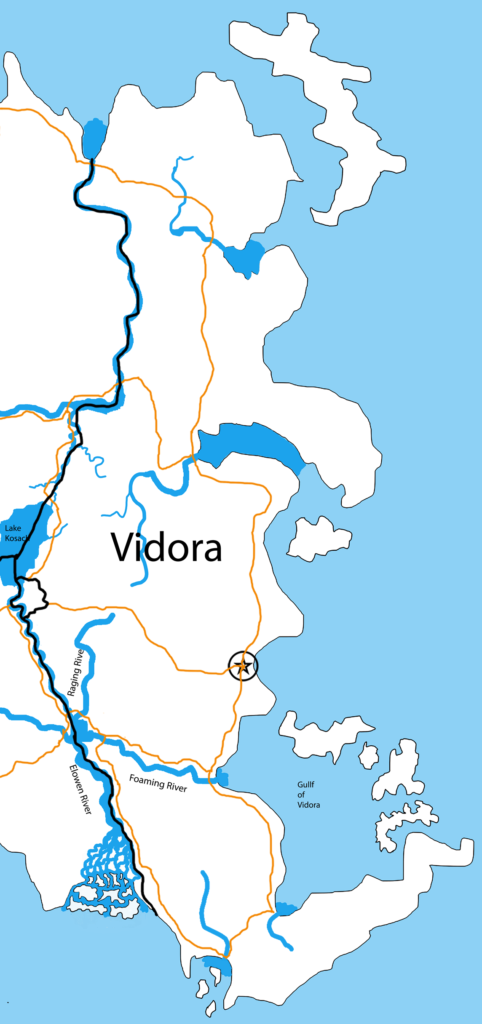
Vidora encompasses the entire east coast of Cendomvita. Scholarly circles classify Vidora as an “island” nation. This is because its western border consists entirely of fresh water from Lake Kosak. Meanwhile, saltwater seas define its northern, southern, and eastern reaches. This aquatic perimeter grants Vidora a distinct geographic and cultural identity.
Vidora’s capital is Ostengate, a carefully planned port city. A network of straight boulevards radiates from the palace at its center. Furthermore, thick, high walls fortify the landward side. The city houses the prominent Guild headquarters for every major industry. Because it commands a deep-water harbor, Ostengate serves as the trade center of the east. It also acts as the primary base for Cendomvita’s largest navy and shipping fleet.
Vidora’s monarchy has always remained strong and fair. Their rule balances order with confident prosperity. Consequently, these rulers have earned a legacy of decisive leadership. They step up during times of crisis and dispatch swift aid after storms. They also broker peace when wars threaten Cendomvita and assist with reconstruction long after battles fade.
Elowen borders Vidora on the southwest. Additionally, the Eslading free trade zone sits along the middle coast, while Rusmaria claims the northwest. At the western edge of Vidora, the Central Mountains give way to rugged foothills and steep-cut valleys. Coastal plains extend fifty miles inland, where salt-warmed breezes carry the calls of distant gulls.
Tall, ancient coniferous forests claim northern Vidora. Their resinous scent clings to the cold air. In contrast, beautiful deciduous forests blanket the southern regions. These woods burst with color during the short, brilliant autumns.
Forestry, mining, agriculture, trade, and fishing fuel the economy. Specifically, the eastern sea and the Gulf of Vidora yield an unmatched variety of sea creatures. Each dawn, the harbors fill with the clatter of crates and the briny smell of fresh catch.
Rusmaria [RUHS-MAR-EE-YAH]
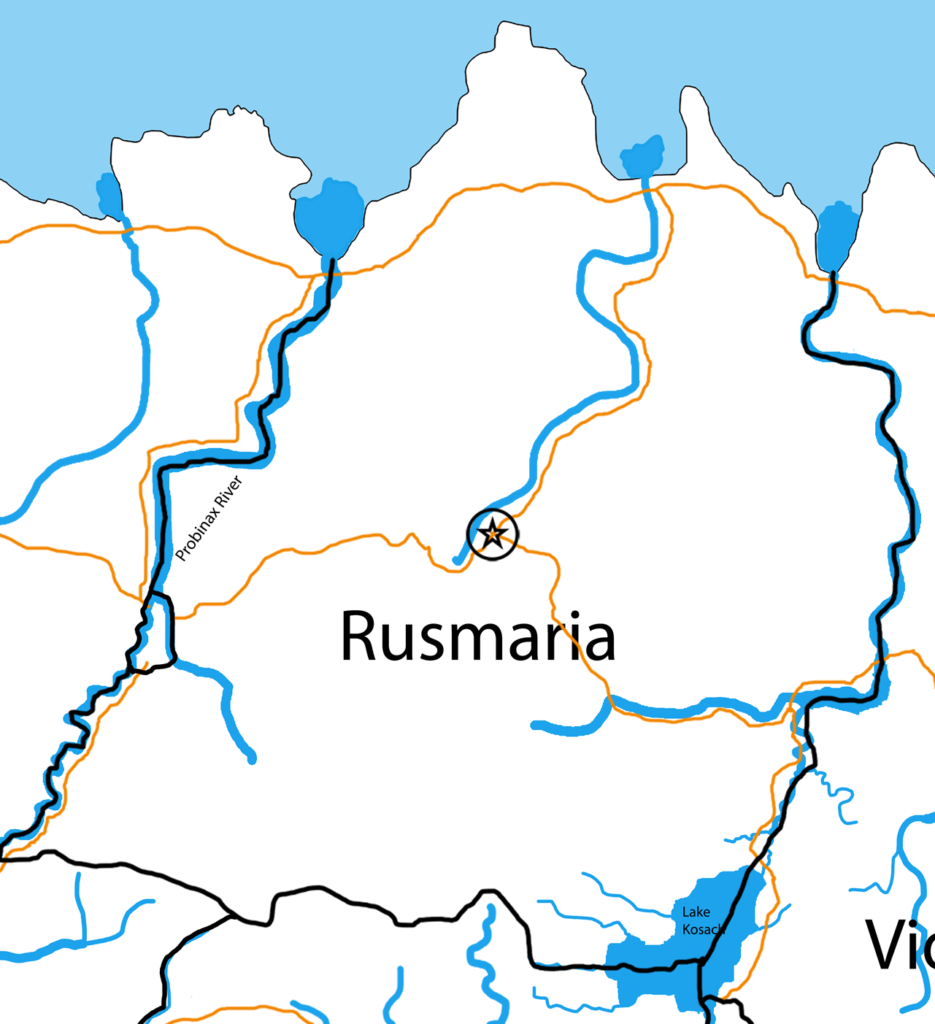
Rusmaria stands on Cendomvita’s northern coast. It is bounded by Vidora to the east and Yisea to the west. To the south, the unforgiving central mountains mark the borders where Rusmaria touches Elowen and Ognenstrof. Carved into the harsher edges of the continent, this kingdom reflects endurance rather than abundance.
Neighbors have long regarded Rusmaria as a peripheral power. However, it has survived precisely because it never relied on comfort or excess. Its people value discipline over luxury and preparation over optimism. Instead of large cities, small villages dot the landscape. Dense northern forests and rising mountains dominate the terrain. Consequently, each generation grows up with a clear understanding of scarcity, vigilance, and consequence.
Rusmaria exists because of its natural resources rather than its arable land. Specifically, mining, lumber, fishing, and hunting for the fur trade form the backbone of the economy. The forest soil is poorly suited to large-scale farming. Yet, determined villagers maintain small plots. They coax modest harvests of vegetables from the land through persistence rather than fertility.
Rusmarian politics mirror the land itself. The system is pragmatic, guarded, and slow to change. Leaders enter alliances cautiously and abandon them only at great cost. Loyalty runs deep once earned, but trust is never freely given. Power is maintained through preparedness and reputation. This makes Rusmaria a quiet but consequential presence within the Seven Kingdoms.
When wider conflicts ripple across Cendomvita, Rusmaria rarely ignites them. Instead, it waits, watches, and endures. It continues to survive even as other kingdoms fracture beneath the weight of ambition.
Yisea [YIH-SEE-AH]
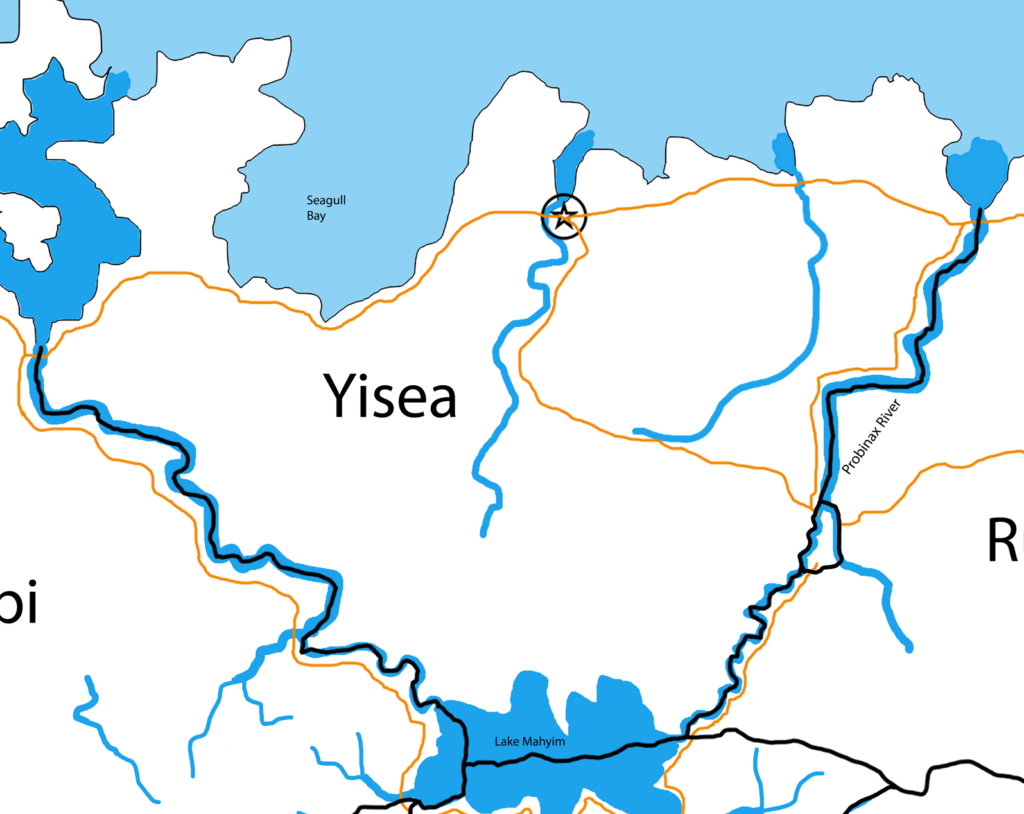
Yisea, also known as the Yisean Empire, lies between Maghrabi to the west and Rusmaria to the east. To the south, the Central Mountains stretch across Yisea’s southern third. These peaks rise steeply from the shores of Lake Mahyim (MAH-HIGH-YEEM). They slowly descend into the desert and rolling foothills, which define Yisea’s southern border. As one travels east, the western plains give way to forested foothills and dense woods. To the north lies Seagull Bay. This large crescent inlet of the Northern Ocean features sheer white cliffs. It remains a striking destination for travelers wealthy and bold enough to brave the stormy northern trade winds.
The Valenrun [VAH-LIHN-RUN] River runs swift and narrow from the southern highlands. It flows through Yisea’s rolling grasslands into the sea. The river deepens and widens only near its mouth. This is where Caerwyn, Yisea’s capital, is located.
Yisea earns its reputation mostly through its herds and ranches. Consequently, it boasts the finest cavalry in all Cendomvita. Unlike Rusmaria, Yisea has a history of aggression without territorial ambition. Some scholars speculate that Yisea’s monarchs initiate conflict out of restlessness rather than need. Others suggest that Yisea offers its strength to any cause that promises disruption. This includes everything from border skirmishes to distant uprisings.
Because of the northwestern desert and sparsely populated interior, Yisea has only one major road. The Northern Trade Route generally follows the coast across the empire. Additionally, Yisea boasts excellent fishing in Seagull Bay. There, chalk-white cliffs tower above the cold and turbulent waters.
Maghrabi [MAH-GRAH-BEE]
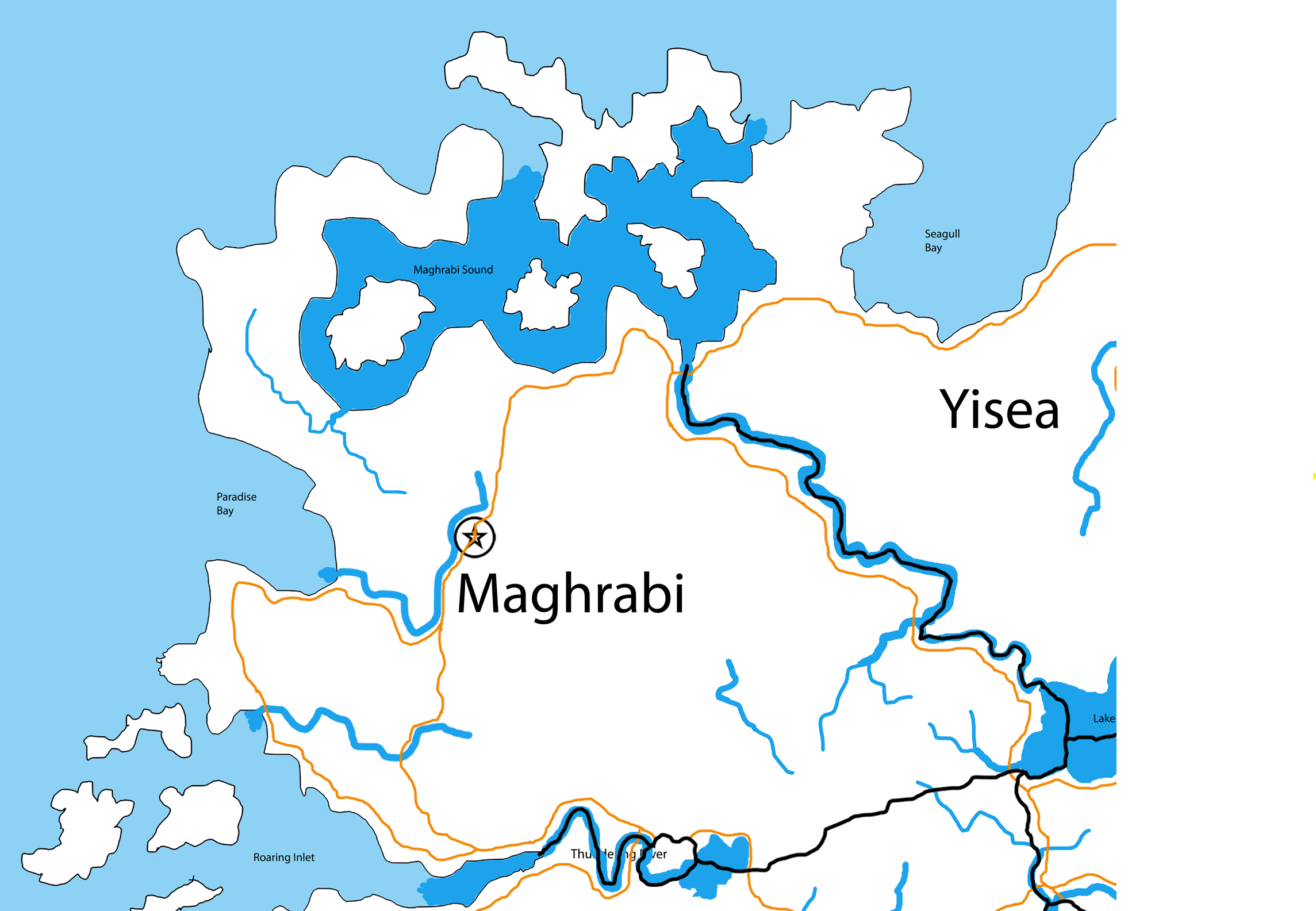
Maghrabi lies in northwestern Cendomvita. Its coastal foothills and the Maghrabi Sound to the north are blanketed in lush forests. These woods provide rich timber for coveted shipbuilding supplies. However, the desert extends from the coastal plains toward the south and west. This arid expanse stops at the base of the Central Mountains and near the Olydran [OH-LEE-DRAHN] River. This river forms Maghrabi’s western border with Yisea.
To the east, Maghrabi is bordered by Yisea, and to the south by Hireotha. Fertile plains emerge as one approaches the Yisean border. The Maghrabi Sound defines the kingdom’s northern border. This area includes four main islands and two outlets to the Northern Ocean. Maghrabi’s capital, Thalyra [THAH-LEER-AH], rests where the foothills meet the advancing sands. It stands guard at the edge of two worlds.
Maghrabi’s economy thrives on the export of fine desert glass, rare minerals, and aromatic resins. Merchants from across Cendomvita also seek out the timber from the northern forests. Although Maghrabi is friendly to its neighbors, it maintains a highly responsive tribal military structure. This system is rooted in clan allegiance rather than centralized command. Consequently, the desert peoples remain vital to national defense.
Because more than half of Maghrabi is coastline, the Pirate Guild exerts a clandestine influence along remote shores. Maghrabi’s small but formidable navy works to counter this threat. They use their resources to protect trade routes and hunt pirates as a point of pride.
Hireotha [HIH-REE-OH-THAH]
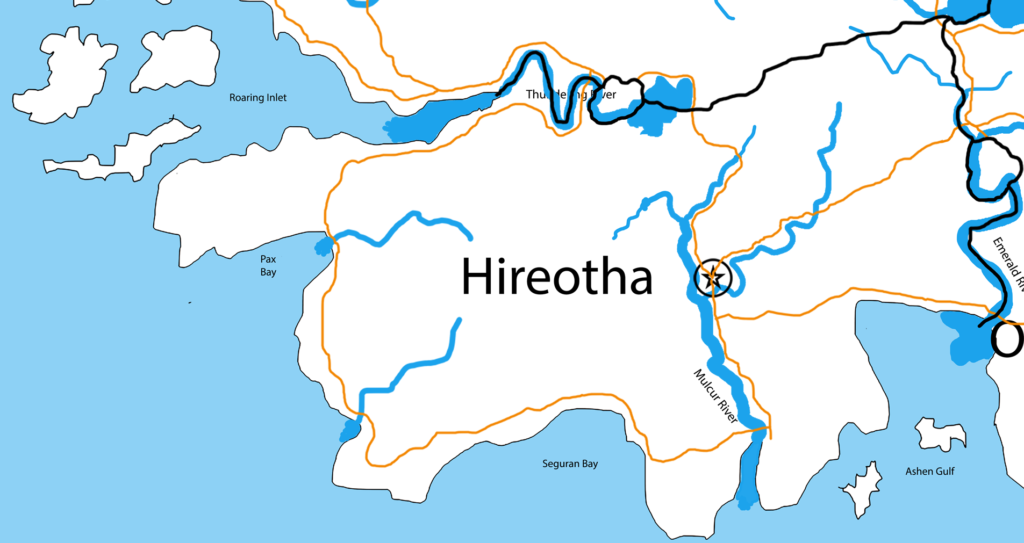
Hireotha sits in the southwestern corner of Cendomvita. Its capital, Maadigan (MEH-ADD-IH-GAHN), is located high on the Mulcour (MUHL-COOR) River. This river remains ocean navigable deep into the interior. Consequently, Hireotha’s position makes it the only kingdom with direct access to two Free Trade Zones: Weslading and Solading. Much of its coastline features rocky cliffs. However, several broad bays support active ports and sheltered harbors. Busy fishing villages also lie along the Ashen Gulf. Hireotha boasts broad farmland and consistently favorable growing conditions. Furthermore, the kingdom earns respect for its strict laws and dependable justice. This reputation fosters both prosperity and security.
Maadigan has long served as the continent’s premier center of learning. It is home to prestigious archives and scholars. The crown sponsors the Royal Maadigan University, which is the foremost center of academic research in Cendomvita. Additionally, the crown supports the Cendomvitian Academy for Military Strategy. Here, officers and tacticians from across the continent study war and governance. Like Ostengate, all major guilds maintain representation in Maadigan. This makes the city the most influential commercial hub in the western kingdoms. Paradoxically, the Pirate Guild and the Thieves Guild also maintain a strong presence in the underworld. They thrive in the quiet spaces beneath the city’s academic and civic order.
The kingdom shares borders with Maghrabi to the north and Ognenstrof to the east. Part of the northern boundary with Maghrabi consists of the Thundering River, which empties into the Roaring Outlet. Meanwhile, the Central Mountains and the Emerald River define the eastern border. These high foothills mark the transition between the two kingdoms.
Elowen [EH-LOH-WHEN]
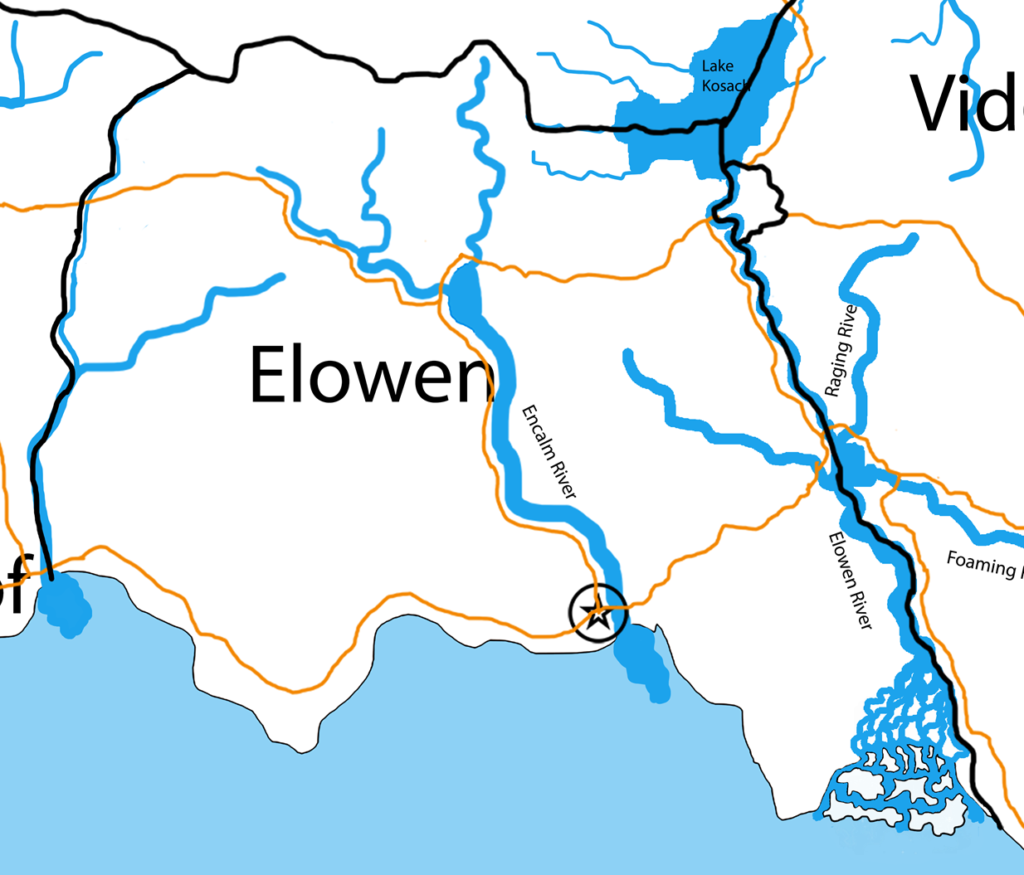
Elowen is a kingdom located on the continent of Cendomvita. It lies just west of Vidora on the southern coast. Its capital, Elmsdover, sits at the mouth of the Encalm River. Much of Elowen consists of fertile, low plains. These plains stretch inland beneath wide, open skies.
The Deep River defines the eastern border. This river flows from Kosak Falls and cuts through a great canyon until it reaches Lake Irreamptum. From there, the Deep River joins the Elowen River along the Vidoran Escarpment. Together, they form a large, swampy delta where reeds whisper above slow waters. Consequently, the land here features broad, humid swamps alive with the sharp scent of peat.
To the west, the Emerald River separates Elowen from Ognenstrof. The land along this river rises into low foothills. Here, small farms cling to higher ground to avoid frequent floods. Northern Elowen extends into the great Central Mountains. In these cooler highlands, hardy villages and herds thrive among the stone.
Major trade routes cross northern and southern Elowen. One route follows the Elowen River to the northern trade network. Another follows the Encalm River from the capital of Elmsdover. Seasonal caravans carry modest wealth along these roads toward the heart of the continent.
Elowen is primarily an agricultural kingdom. Its products range from grains to exotic plants and cultivated fungi. Rich black soil and frequent coastal rains nourish these crops. Since Cendomvita is pre-industrial, fresh produce rarely travels far. Therefore, durable grains remain the primary export. This makes food security both a strength and a vulnerability for the kingdom.
Historically, Elowen’s monarchs have maintained a notoriously hands-off leadership style. They frequently allow advisors and courtiers to handle the details of ruling. Many rulers indulge in decadent vices. While the crown pursues pleasure, governance drifts into the hands of those who understand power.
Ognenstrof [AHG-NIN-STRAF]
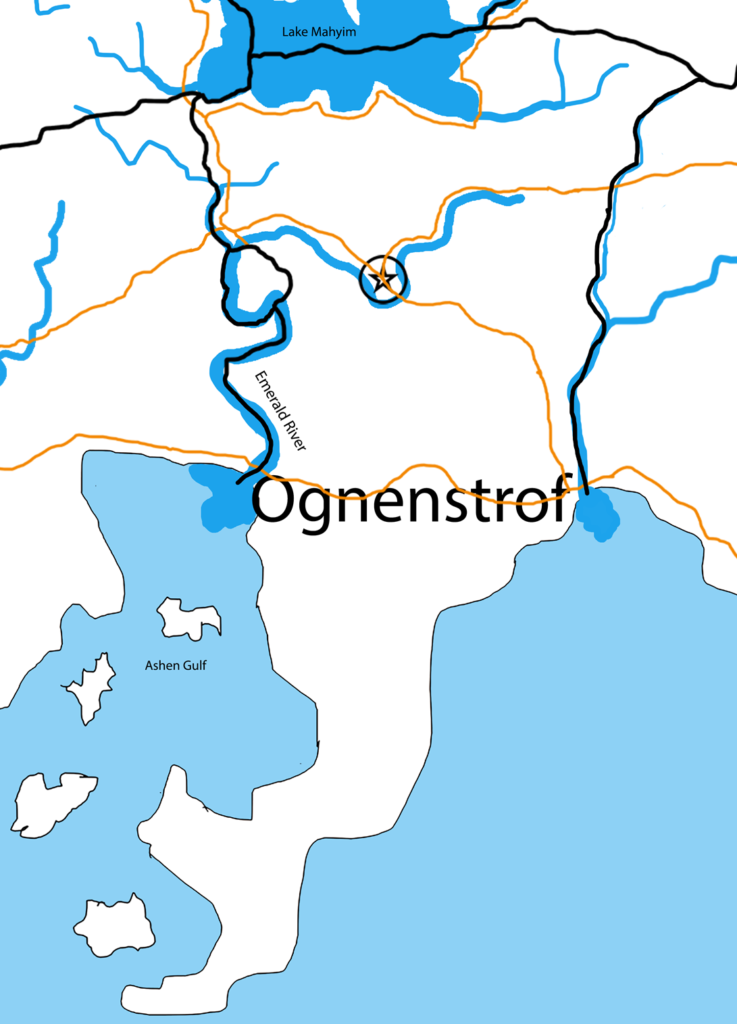
Ognenstrof sits between Elowen on the east, bounded by the Avenreach (AH-VIHN-REECH) River, and Hireotha, bounded by the Emerald River on the west. To the north it meets Yisea and Maghrabi, while to the south it shares a short border with Rusmaria at the edge of the Central Mountains. Although Ognenstrof controls the Ashen Peninsula, this volcanic region remains largely uninhabitable. With so many neighbors and access to multiple waterways, Ognenstrof occupies one of the most strategically connected positions in Cendomvita. Because of its multiple borders, its monarch maintains a strong and highly mobile army and Cendomvita’s only freshwater navy, stationed on Lake Mahyim.
Draventh (DRAH-VINTH), its capital, is both the largest city in Cendomvita and the most densely populated. The Emerald River flows through Draventh before turning south to meet the Ashen Gulf, while the Avenreach River supports a vital eastern trade corridor along the border with Elowen. These waterways sustain commerce deep inland and bind the capital to the sea.
Ancient settlements on both sides of the peninsula suggest that Ognenstrof may be home to some of the oldest continuous habitation in Cendomvita. The region’s wealth is driven by gem mining, a legacy of its ancient volcanic terrain. Ognenstrof has always attracted enterprising and fiercely independent people, so some say that it is second only to the Free Trade Zones in looseness of law.
Autonomous Free Trade Zones border each of the Seven Kingdoms. These zones sit roughly at the major cardinal directions. Unlike the kingdoms, councils govern these zones. Each council consists of one representative from every major guild and a set of elected members. Furthermore, the councils appoint a president to conduct meetings. This leader casts tie-breaking votes, ensuring guild-aligned leadership.
The Free Trade Zones house the primary headquarters of most major Guilds. Consequently, these areas serve as hubs for training, governance, and strategic operations. This concentration of power grants the zones significant political influence. Specifically, the Transportation Guild often guides long-distance economic policy. Throughout their long history, no kingdom has ever dared to assault a Guild House in Cendomvita.
As a result, these zones exercise both economic and political autonomy. They shape the regions they intersect through careful policy. Each zone sustains a strong military presence and a highly professional law enforcement industry. These elite forces are powerful enough to defeat the army of any single kingdom. This unmatched deterrence makes the Free Trade Zones the safest places to live and work in Cendomvita.
Eslading is located in a large valley at the southeastern base of the Central Mountains. The city of Eslading serves as the regional capital. It is positioned at the crossroads of the eastern north-south trade route and the southern east-west route. These roads run directly along the edge of the Central Mountains.
Eslading borders Vidora and Elowen at Lake Kosak. It also connects trade into eastern Rusmaria. This makes Eslading a vital distribution hub for goods entering or leaving the eastern interior. Because it serves as a shortcut from Vidora’s ports to northern markets, caravans and river barges rely on this zone to bypass the long coastal circuit. Consequently, this location grants the zone an outsized role in Cendomvitan commerce.
The Eslading Council has historically maintained strong ties with the Vidoran monarchy. This is largely due to its proximity to Ostengate. Although distant from Maadigan, Eslading has sent many prominent citizens to study there. These scholars attend the Royal Maadigan University and the Cendomvitian Academy for Military Strategy. These academic ties help Eslading cement close relationships with Hireotha’s intellectual and military elite.

Nolading is the only Free Trade Zone connected to a mountain interior route. This path runs directly through the heart of the Central Mountains. It allows for rare passage across the continent’s rugged interior.
Neither Yisea nor Rusmaria are well populated. Therefore, Nolading remains the smallest and least populated of the Free Trade Zones. However, its crossroads location ensures a continuous flow of people. Merchants and travelers constantly pass through the zone, maintaining its relevance in the northern economy.
Nolading sits strategically on the Probnipex River along the Rusmaria–Yisea border. It marks the last point inland where ocean-going ships can navigate. Additionally, it is the first place where travelers can bridge the Probnipex River. This creates a natural convergence of routes. Consequently, Nolading is essential for both travel and trade.

Weslading is located on the western edge of Lake Orendil. This is the westernmost of Cendomvita’s great lakes. The zone sits directly on the border of Maghrabi and Hireotha. Interestingly, Weslading sits at an altitude of approximately one mile. This unique position exists despite its proximity to the Roaring Inlet. Consequently, the local climate is a place where mountain air meets coastal storms.
Weslading serves as the primary connection between the sea and the Maghrabi desert. The roads into the city are quite steep. However, its proximity to Maadigan allows certain goods to move efficiently between northern and southern markets. This makes Weslading a valuable shortcut for select trade flows across the western kingdoms.

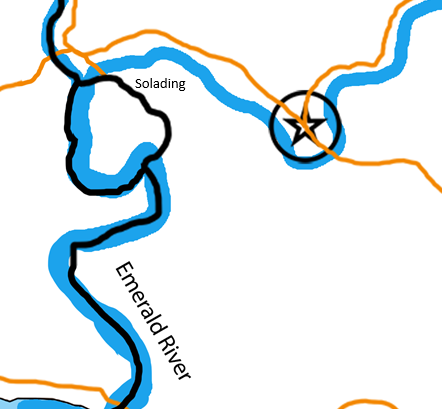
Solading sits less than 100 miles from Draventh, Ognenstrof’s capital. It also remains less than 300 miles from Maadigan, Hireotha’s capital. This strategic location is vital because ocean-going vessels cannot travel further upriver. Consequently, Solading serves as the final deep-water port on the inland route. The southern east-west trade route crosses just north of the city. This position places Solading at the heart of western commerce.
Unlike other Free Trade Zones where the Transportation Guild is supreme, the Information Guild wields the most influence here. They guide both policy and surveillance across the entire region.
Solading is home to the first Information Guild House. Historians believe a refugee named Messo established it millennia ago. Archaeological evidence suggests that Solading grew from one of the oldest settlements in Cendomvita. From the city, residents have a clear view of the Central Mountains to the north. They can also see distant smoke rising from the volcanoes of the Ashen Peninsula to the south.
By far, Solading is the most densely populated of the Free Trade Zones. It exists as a bustling crossroads where northern, southern, and maritime routes all converge.
Geography and Natural Features
The Central Mountains dominate Cendomvita. This range begins near the Fountain of the Roaring River in the west and stretches eastward. As the mountains move toward the Vidoran Divide, they grow in both elevation and breadth. Consequently, this range is defined by tall, jagged peaks and deep, inaccessible valleys.
The Cendomvitan Great Lakes
Three prominent freshwater lakes sit within these mountains. These bodies of water serve as the heart of the continent’s ecosystem:
- Lake Kosak: This lake is famous for its rare bifurcated drainage across the continental divide. Despite its high elevation, Lake Kosak feeds rivers flowing toward both the North Sea and the southern plains.
- Lake Mahyim: As the largest and deepest lake in Cendomvita, Mahyim sits just north of the continental divide. It touches the borders of four kingdoms. Therefore, it serves as a vital resource for water and trade.
- Lake Orendil: This is the westernmost of the great lakes. It forms the headwaters of the Roaring River within a peaceful valley. Notably, cliffs of barren flat rock create a windy channel to the west. Travelers know that the “roar” comes from the wind rushing through the gorge rather than the water itself.
Rivers and Borders
The continent’s major river systems largely shape the borders of the Seven Kingdoms. For example, the unusual drainage of Lake Kosak creates a “nominal island” in Vidora. This kingdom remains separated from the mainland by two major rivers. Similarly, Yisea exists as a nominal island. Lake Mahyim forms its southern border, while the Olydran and Probnipex rivers define its eastern and western boundaries.
The Ashen Peninsula
The Ashen Peninsula is another defining feature, located within Ognenstrof. This region contains a chain of volcanoes. While many are now dormant, others remain mildly active. This volcanic chain extends into the southern Central Mountains. As a result, the region experiences both seismic instability and immense mineral wealth.
The Records
Cendomvita serves as the central setting for several major chronicles. These include The Mushkinek Uprising, The Vidoran Crisis trilogy, and the upcoming Eslading’s Exiles trilogy. Furthermore, these lands anchor the broader stories of Hile and Phine.
Throughout much of their recorded history, the inhabitants believed Cendomvita comprised the entire known world. This perspective shaped their culture and politics for generations. Consequently, any mention of lands beyond the sea remains a matter of myth rather than maps.
/series/historical-accounts/Early History
The Vidoran Crisis
Eslading’s Exiles
About Orudara: The Forgotten Homeland
Click to Navigate About Orudara
Origins
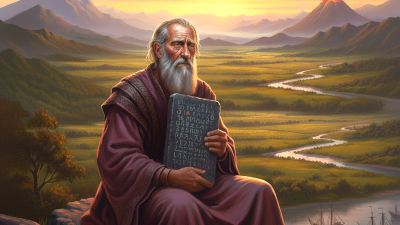
Long before the Seven Kingdoms rose, Orudara existed. It was the first land and the cradle of humanity. Furthermore, it served as the wellspring for every people who walk the earth today. This was true long before the founding of Maadigan or the forging of the Free Trade Zones.
Modern scholars believe Orudara lies far to the south of Cendomvita. It sits across the same ocean that carried the earliest refugees to the northern continents thousands of years ago. For much of history, people regarded its existence as a mere myth. However, scattered records and fractured stone tablets eventually revealed a different truth. Rare returned voyagers confirmed that Orudara is older than any crown or council.
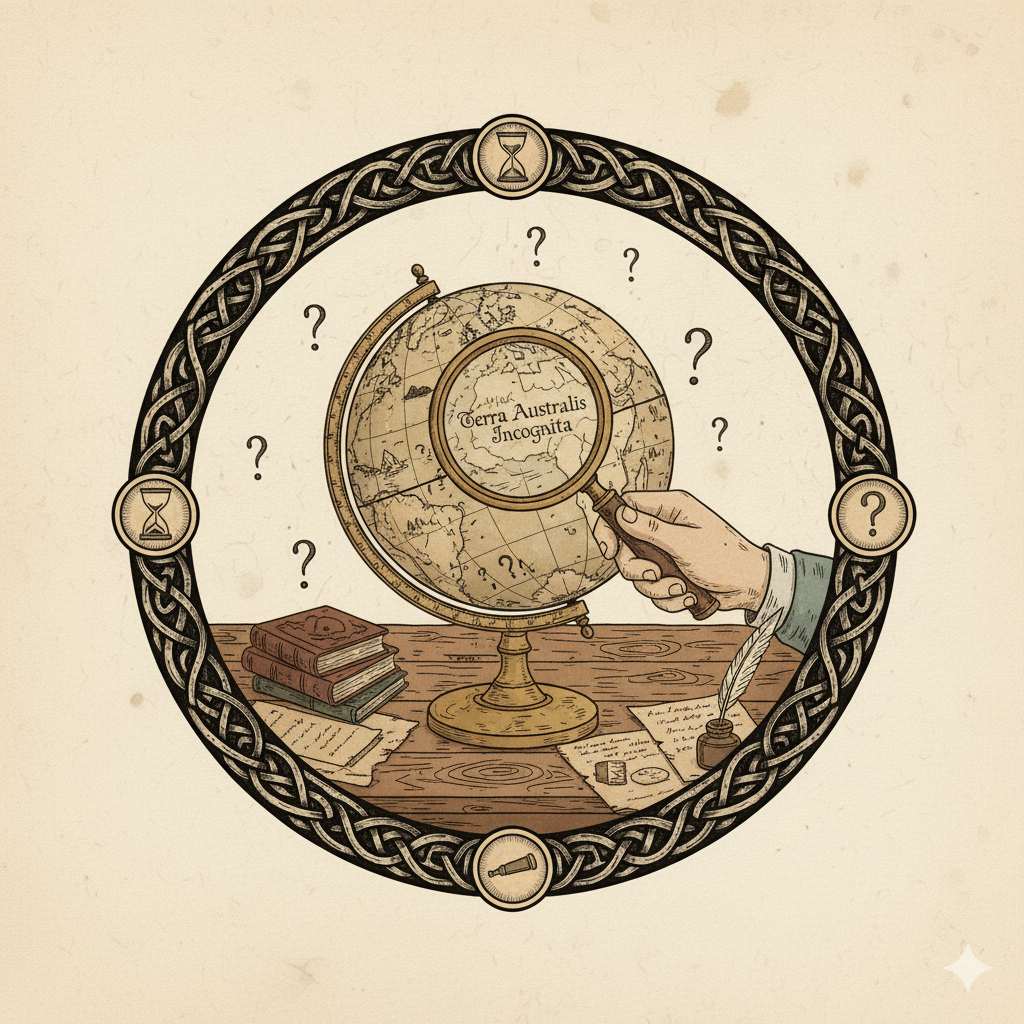
Because geographers long doubted its existence, they never speculated on its shape or size. For millennia, many brave and curious explorers set out southward to seek Orudara. Unfortunately, these ships often vanished without a trace. Despite these tragedies, legends still suggest a continent with a size and climate similar to Cendomvita.
These myths describe a land of forests, mountains, and rivers. This southern continent supposedly fits neatly against Cendomvita’s southern coast like a puzzle piece. For centuries, geologists scoffed at this idea. They called it the greatest fabrication in Cendomvitan history.
The Time of Flight
Legends say that Orudara once flourished with its own kingdoms and guilds. Its people grew prosperous and proud. However, during the “Time of Flight,” a great scourge swept across the land. This event remains unnamed and undefined. History has forgotten whether it was a war, a plague, or a rebellion.
The oldest record in the Solading Information Guild provides the only surviving account. It simply reads:
Thousands fled by sea.
They sailed north.
They reached a new shore.
And then… they forgot.
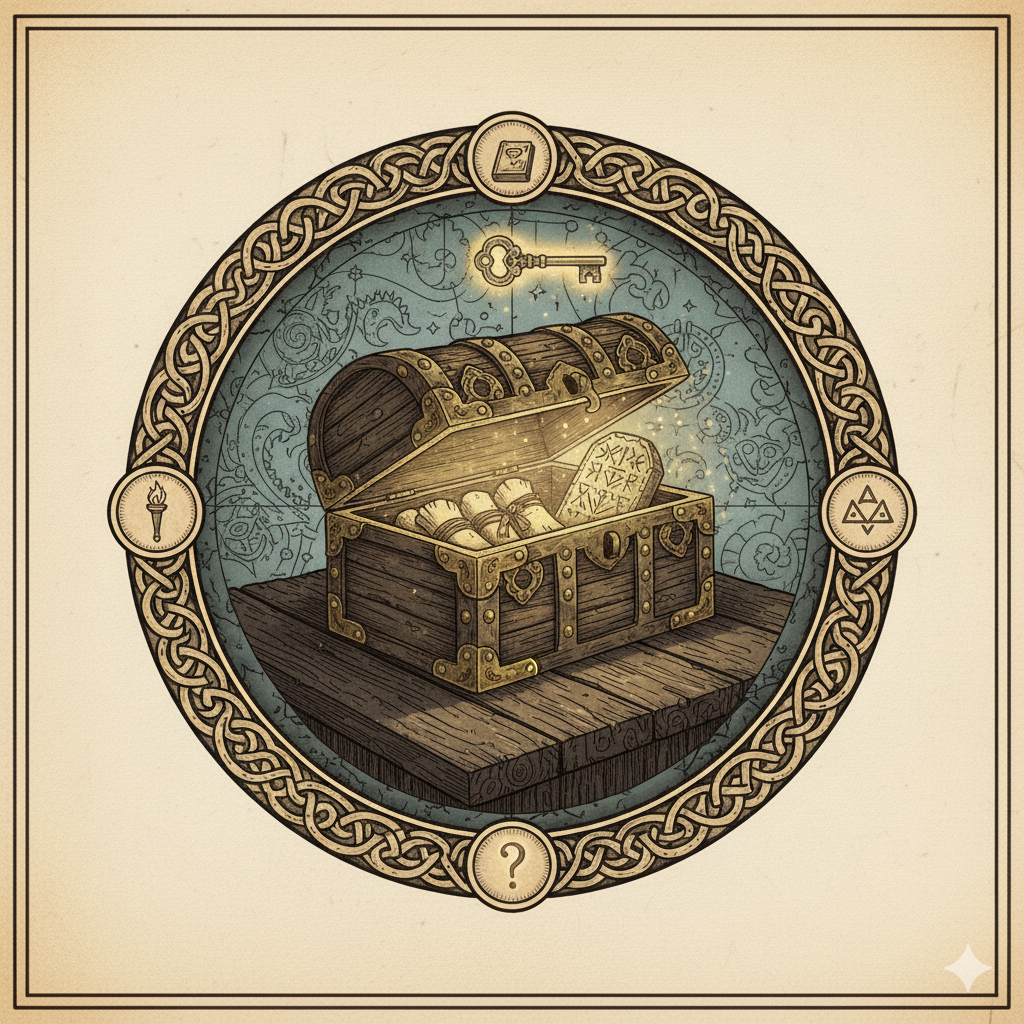
Upon its establishment, the Information Guild guarded the final thread connecting Cendomvita to its true past. Consequently, they fractured the stone tablet that held the account of the migration. They then secreted the pieces throughout the continent to ensure the truth remained hidden.
Today, these shards remain scattered across the kingdoms. Each fragment carries more than just ancient history. Furthermore, they hold the dangerous possibility of a return to the cradle of humanity. This legacy ensures that while Orudara is forgotten, its influence still lingers beneath the surface of the world.
Shortly before the I, Famous Person, disappeared from Cendomvita, a group of refugees landed on the southern shores of Ognenstrof. They carried a fantastic tale of flight from Orudara. Specifically, they fled just before the event now known as the Raven Cataclysm. These travelers bore the first modern records of Orudara’s existence, shape, and size.
The refugees spoke of indigenous people who welcomed them and taught them the lay of the land. Furthermore, they described ancient cities that forests and jungles had long since reclaimed. Their stories touched on peace and prosperity, as well as plagues and conflicts. Most importantly, they brought back tales of a great scourge. Their forefathers believed they had left this affliction behind, but they had actually carried it with them.
This scourge lay dormant for years before erupting into localized outbreaks. At first, these events occurred decades apart. However, the outbreaks eventually became more frequent and concentrated. This led scholars to label them as epidemics. Finally, the entire continent became infected. This final pandemic forced the refugees to return home to Cendomvita.
The Nature of the Scourge
The refugees assured the gathered scholars that this scourge was not traditionally contagious. Instead, it was the scourge of selfishness. This affliction manifests as the waning of compassion for fellow human beings. During their two centuries in Orudara, the refugees discovered that the indigenous people had suffered the same fate thousands of years earlier. Only a few had survived. Their mutual need for survival eventually burned out the disease. Unfortunately, the Cendomvitan refugees unwittingly brought the scourge back to the northern shores.
Records Set in Orudara
Orudara is one setting for the short story, Before the Seven Kingdoms, and is the planned setting for an epic spanning more than two centuries of civilization. For now, however, the existence of Orudara remains a mystery to all but the select few who read this page.