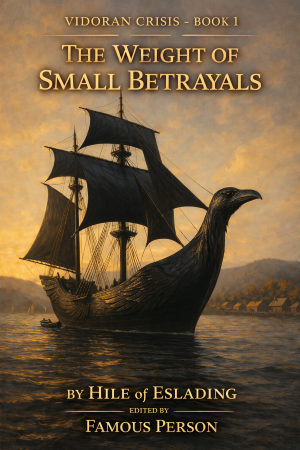
A novel of power, compromise, and the slow violence of consequence
By: Hile of Eslading
Editor: Famous Person
Each Decision is a crossroads
At what point does the exercise of our greatest strengths become an act of betrayal against those we lead?
Are we defined by our public oaths or the private compromises we make to survive them?
The Weight of Small Betrayals is A Record of Intimate Ruin
Reader Advisory
This story contains scenes of intense violence against men, women, and children. Its contents and themes are intended for mature audiences (18+). Reader discretion is advised.Series
Step inside and see what your choices could cost.
The Weight of Small Betrayals Page Map
Teaser
Cendomvita has known relative stability for more than two centuries since the fall of Mushkinek’s uprising, but stability has never guaranteed safety. When the Ravens strike Neverharbor, the news reaches most of Vidora only as rumor, fragmented and unconfirmed, easy to dismiss by those who benefit from disbelief. Distance dulls urgency. Comfort encourages denial.
Hile, a historian and well-established transporter of goods, accepts a questionable commission at the edge of that denial. He does not seek danger. He seeks continuity. Yet the choice pulls his family into motion without certainty or guidance, forcing each of them to act before understanding the cost. A life built on routine and careful order gives way to a narrowing field of options, each shaped by fear, responsibility, and the consequences of delay.
Betrayal does not arrive all at once. It accumulates through small concessions, quiet rationalizations, and choices made to avoid worse outcomes. Each decision feels survivable in isolation. Together, they reshape loyalty, duty, and self-understanding.
The Weight of Small Betrayals examines how betrayal serves different ends and carries unequal weight. The elder son chooses betrayal as strategy, advancing personal ambition through deliberate compromise. Each concession erodes restraint and accelerates collapse. The younger endures betrayal instead of wielding it, accepting moral compromise not for gain but for preservation. He learns to navigate uncertainty in service of others, even as clarity slips away.
Both paths move forward. Only one moves toward ruin.
Character Types
The Architects and The Adversaries (Primary Characters)
These primary characters drive the story. The story explores their lives and decisions along with the associated consequences. They remain deeply involved in the narrative’s major conflicts, themes, and emotional arcs. Furthermore, most chapters follow or reference one or more of these individuals directly, as their choices often shape the world around them. Consequently, understanding their motivations is essential to grasping the weight of the coming crisis.
Supporting Figures (Secondary Characters)
These characters play important supporting roles. They may serve as allies, foils, mentors, or obstacles to the primary characters. While they do not dominate the story, their presence is frequent, and they often experience meaningful development or contribute significantly to subplots.
Notable Mentions (Characters Mentioned)
These are characters who appear briefly or are referenced in dialogue, letters, memories, or historical accounts. They help to populate the world, provide context, or influence the story indirectly. Although they may not take part in major scenes, their named existence provides richness to the scenes in which they are mentioned.
Characters
Primary
Secondary
Mentioned
Continue your journey through The Vidoran Crisis with Book 2: The Shadow of Silent Losses.