A record of The Power of Complicity
By: Herte of Hireotha
Edited by: Famous Person
He didn’t build an army
When does the observer become the accomplice?
When does silently witnessing become participation?
he built an ideology
Reader Advisory
This story contains scenes of intense violence against men, women, and children. Its contents and themes are intended for mature audiences (18+). Reader discretion is advised.Series
Step inside the mind of the man who turned an entire Continent into a bystander.
The Mushkinek Uprising Page Map
Teaser
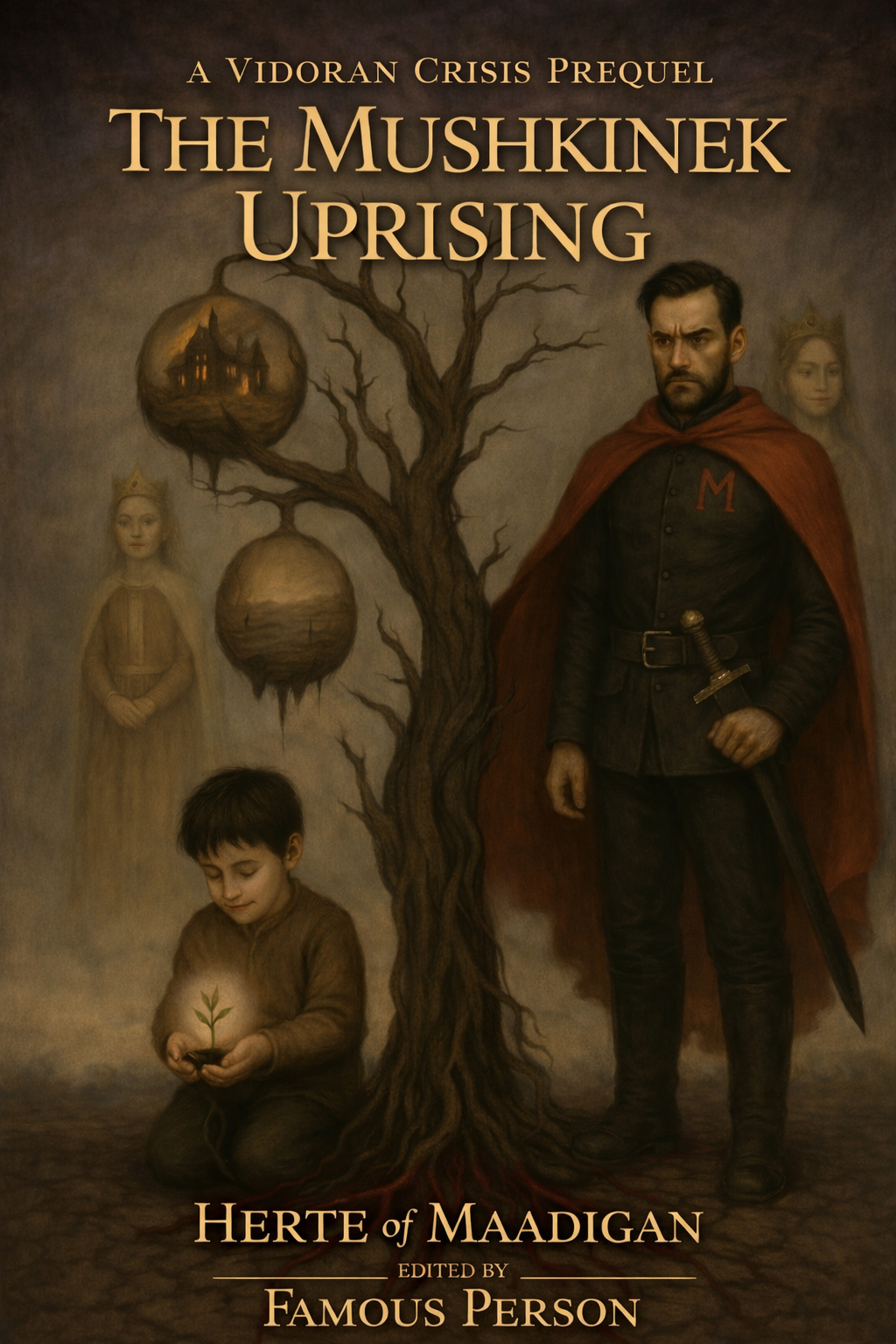
They say the Mushkinek Uprising began with a glance rather than a sword or a throne. It started with a boy watching a girl who would one day be queen. He was the son of a merchant. She was Ta’arah of Hireotha, born to light and lineage. He told no one what he felt that day. Instead, he made a private decision. He would have her.
Mushkinek was neither conqueror nor king at first. He was a boy who wanted a queen, and he learned early that desire alone was not enough. He built patiently. He gathered influence instead of armies. He shaped belief instead of issuing commands. By the time his intentions became visible, resistance had already narrowed. When he finally took me, the machinery was complete.
I met Mushkinek not as a dreamer, but as a tyrant. He made my purpose explicit from the beginning. I would write what he did, or I would die.
I am Herte, a scholar of history held close enough to observe the uprising as it formed. I witnessed councils shift, bribes circulate, and laws change through careful increments that appeared reasonable in isolation. Each step preserved the illusion of order. Each step carried a cost.
I told myself I was only recording. I told myself distance protected truth. Proximity proved otherwise. Curiosity sharpened where resistance dulled. This is not a story of gods or monsters. It is an account of what happens when the instinct to know outlasts the instinct to refuse.
I continue to write because once you understand how power is built, looking away becomes its own kind of lie.
Character Types
The Witness and the Architect (Primary Characters)
Because an eyewitness and reluctant biographer recorded these events, the Mushkinek Uprising features a focused cast of main characters. The following figures are the central individuals who drive the story forward.
These people are deeply involved in the major conflicts, themes, and emotional arcs of the narrative. Consequently, most chapters will follow or reference them directly. Their personal choices often shape the world around them, proving that the Mushkinek Uprising was built on the back of individual ambition and sacrifice.
The Primary Characters section provides brief personal sketches for Herte, the witness, and Mushkinek, the primary architect of the Mushkinek Uprising. While one man built the machine of revolution, the other was forced to document its gears.
Understanding these two figures is essential because their relationship defines the entire narrative. Because Herte provides the perspective and Mushkinek provides the power, their intersection creates the friction that drives the Mushkinek Uprising forward. Consequently, these sketches offer a glimpse into the internal motivations behind the external conflict.
Agents of the Uprising (Secondary Characters)
The Mushkinek Uprising involves a vast network of characters from across the entire continent of Cendomvita. Although these figures were not the primary architects of the conflict, they played noticeable roles in the final outcomes of the war. Because their influence was felt in every kingdom, understanding these agents is essential to understanding the sheer scale of the revolution.
Many of these characters are complex enough that they could have their own stories written in detail. Specifically, their lives before, during, and in some cases after the Mushkinek Uprising ends provide a rich tapestry of the era. Although their roles did not drive the main narrative, their individual choices often served as the friction or the fuel that allowed the uprising to spread so far.
Census of the Caught (Mentioned Characters)
The Mushkinek Uprising mentions several characters whose roles do not explicitly or significantly impact the primary narrative. While these figures may seem minor, their experiences provide a broader perspective on the scale of the conflict. Often, these individuals were snatched out of their own lives to play specific roles that Mushkinek had devised for them.
Because the architect of the revolution viewed people as tools, many found themselves forced into service without warning. If they were lucky, these individuals survived the turmoil and returned to live out their lives in the aftermath of the Mushkinek Uprising. However, the psychological and social scars of their involvement often remained long after the fighting ceased.
Consequently, this census serves as a record of those caught in the gears of history. Although their names might not appear in the great military chronicles, their presence is essential to understanding the human cost of the era. By documenting these peripheral figures, we gain a clearer picture of how the Mushkinek Uprising reshaped the lives of ordinary citizens across the seven kingdoms.
Characters
Primary
Secondary
- Fendrel
- Gryffid
- Halven
- Kelvor
- Kelyn
- Lazrik
- Marchant
- Noam
- Quen
- Rhaimon
- Rooch
- Salisandra
- Ta’arah
- Zeyra
Mentioned
Follow Mushkinek’s shadow more than two hundred years into the future in The Vidoran Crisis.