
Shaped by Choice, Confronted by What No One Chose
They Prepared for the Wrong War
Choice is but the beginning. Where are yours leading you?
As Trust Erodes, The Silent Architecture of the Continent Follows Suit, Yielding to a Reckoning that has no Solace.
Reader Advisory
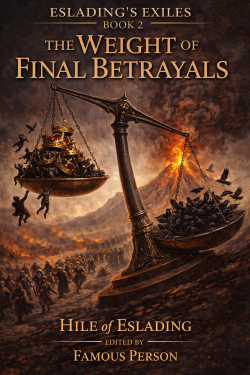
This story contains scenes of intense violence against men, women, and children. Its contents and themes are intended for mature audiences (18+). Reader discretion is advised.Every person suffers from The Weight of Small Betrayals. Few ever discover the weight of final betrayals. Be among those who do.
The Weight of Final Betrayals Page Map
Teaser
The Weight of Final Betrayals, the second book in Eslading’s Exiles, begins with a desperate search for what was hidden in Cendomvita long before their time—fragments of an ancient design scattered across a splintered continent. The mission is clear, but the path is not.
Clues point outward—to distant springs, to forgotten places, to truths buried deeper than memory. Each discovery suggests progress, yet each answer raises a more dangerous question. What was broken was broken on purpose. What was hidden was meant to stay lost.
They believe the danger is known. They are wrong for all the right reasons. They believe they are running out of time. They are right for all the wrong reasons.
Information leaks. Alliances shift. Trust fractures in ways no one fully sees until it’s too late.
Some betrayals result from action. Others are shaped by inaction: in what is not said, in what is allowed to pass, in the quiet assumption that there will be time to correct the course later.
Long ago, Mushkinek learned that nature offers its own betrayals: an early winter, an unexpected storm, the ground moving beneath one’s feet. Its betrayals can also be subtle—a flash flood, a rock slide, a lightning strike.
Now, springs run hot where they once ran cold. The air carries the sharp scent of sulfur, thick enough to cling to the tongue. The ground trembles beneath every step, subtle at first, then harder to ignore. Travel grows uncertain as roads split and crumble. The land refuses to remain as it was, yet still they press forward.
The Exile Council believes it is racing a named enemy—the Ravens. Instead, they are racing something unstoppable: time.
The Ravens can be understood. They can be studied, anticipated, resisted. Time is something else—something older, something indifferent to intent and immune to reason.
In a world shaped by choices, not fate, every decision carries weight.
Some betrayals are deliberate. Others are born of fear, of pride, of the need to believe things will hold just a little longer. A few are made with full knowledge of their cost—and carried forward anyway. And some come too late to matter.
As the Exiles move south, pressure builds behind them—unseen, unmeasured, undeniable. What begins as unease becomes a pattern. What feels isolated begins to connect. The signs were always there. They were simply easier to dismiss than to confront.
By the time the truth takes shape, it is already in motion.
As the Exiles press forward, one truth becomes impossible to ignore:
not every threat can be fought…
and not every consequence can be survived.
Character Types
The Architects and The Adversaries (Primary)
These are the primary actors recovered from the Eslading diaspora. Their choices during the initial westward retreat dictated the survival of the resistance and the eventual warning of the kingdoms.
Supporting Figures (Secondary)
These characters play important supporting roles. They may serve as allies, foils, mentors, or obstacles to the primary characters. While they do not dominate the story, their presence is frequent, and they often experience meaningful development or contribute significantly to subplots.
Notable Mentions (Characters mentioned)
These are characters who appear briefly or are referenced in dialogue, letters, memories, or historical accounts. They help to populate the world, provide context, or influence the story indirectly. While they may not take part in major scenes, their named existence provides richness to the scenes in which they are mentioned.
Characters
Primary
- Ashira | After the events of this story (spoiler alert)
- Elgyon | After the events of this story (spoiler alert)
- Grimm | After the events of this story (spoiler alert)
- Hile | After the events of this story (spoiler alert)
- Mellue | After the events of this story (spoiler alert)
- Phine | After the events of this story (spoiler alert)
- Saffron | After the events of this story (spoiler alert)
Secondary
Mentioned
Return Frequently to Follow the Progress of Eslading’s Exiles