
A preserved testimony from Thalevir’s Ancient Age
Before the Seven crowns were forged, the warnings were already ignored.
What do we owe to truths we recognize before others do?
When authority refuses to act, do you speak anyway?
Before the Seven Kingdoms: When the past set the future in motion
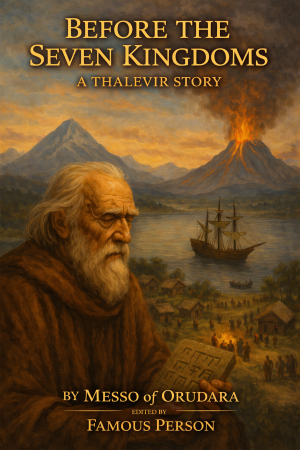
Royal Road ownership verification: Creative Artistic Works, L.L.C., the copyright owner of this work, is submitting it to Royal Road through its Famous Person account.
Reader Advisory
This story contains scenes of intense violence against men, women, and children. Its contents and themes are intended for mature audiences (18+). Reader discretion is advised.Discover how a people survived when their homeland decided they no longer belonged.
Serial Release Schedule
Before the Seven Kingdoms Page Map
Teaser
Long before Cendomvita became the continent of the Seven Kingdoms, Orudara stood as the cradle of human civilization in a world without gods, magic, or fate. Its people built prosperity through order, trade, and hierarchy, trusting structure to secure permanence. Prosperity revealed humanity at its worst. Survival demanded its best.
Before the Seven Kingdoms follows Messo, an Information Guild journeyman trained to gather truth and deliver it without distortion, and Catenum, the chief of the Pirate Guild, whose authority rests on loyalty earned rather than inherited. They come from different orders, bound by no shared purpose, until collapse forces cooperation over comfort. Each understands danger in a different way. Each underestimates how quickly certainty can vanish.
As Telimicas, a former servant, drives an uprising that dismantles Orudara’s social order, the powerful dismiss warning after warning. Distance breeds disbelief. Status delays response. Institutions built to preserve stability prove unable to adapt when stability itself becomes the threat. Survival replaces certainty. When land fails through famine, violence, and fragmentation, the displaced turn to the sea with little more than what they can carry and no assurance of welcome.
What they carry with them threatens their future. Knowledge can expose old divisions just as easily as it can save lives. Skills preserve life even as they invite conflict. Memory anchors identity but resists change. What saves them binds them together, not through idealism, but through necessity.
Between selfishness and solidarity, a choice takes shape. Between endurance and collapse, a new civilization begins to form, shaped not by destiny, but by what people refuse to abandon when everything else falls away.
Character Types
Architects and Adversaries (Primary)
This short story names four characters. These people are deeply involved in the major conflicts, themes, and emotional arcs of the narrative. Consequently, most sections will follow or reference them directly. Their personal choices often influence the world around them, proving that civilizations are shaped by individual ambition, restraint, courage, and sacrifice.
This section provides brief personal sketches for Messo, the messenger, and Catenum the enabler for the salvation of the refugees. Although these men stand at the forefront of this story, Holiana, another major primary character, influenced them both for the good. The final character, Telimicus, is the instigator of the uprising within this story. His impact is of epic proportions, but he is only a mentioned character in the story.
Understanding these figures is essential because their relationships define the entire narrative. The intersection of these characters’ lives creates both the conflict and the resolution in this story. These sketches offer a glimpse into their human experience and internal motivations.
Characters
Primary
- Catenum | After the events of this story (spoiler alert)
- Holiana | After the events of this story (spoiler alert)
- Messo | After the events of this story (spoiler alert)
Secondary
The foundations of Cendomvita were built long before the Seven Kingdoms. Discover how those foundations are tested millennia later in The Mushkinek Uprising.